



Blanketweed and Other Pond Algae
Introduction Algae are primitive aquatic plants that differ from other plants in that they have no true stems, leaves or roots. They have a place in the overall food chain as they convert the energy of the sun into forms that can be used as a food source for other aquatic life. Algae also help to increase dissolved oxygen in water. Algae grow in both fresh and salt water systems There are said to be over 20,000 different named species of green algae. |
|
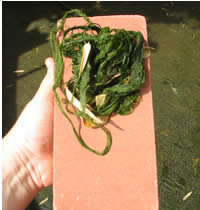 |
Blanketweed |
Algae occur in three different basic forms. These are categorised as planktonic, filamentous and macrophytic.
Planktonic Algae
These are single-celled microscopic plants that float freely
in pond water. When planktonic algae are very abundant, they
make the water turn green. This is known as an algal “bloom”.
More infrequently, the colour of the water can be turned into
other colours, eg yellow, brown or red.
They include genera of cyanobacteria (the blue green algae, eg Gloeocapsa, Synechococcus, Microcytis) or one of several species of green algae genera (eg Euglena, Scenedesmus, Chlamydomonas).
Filamentous Algae
These algae form as thread-like structures that can be floating
or attached to submerged items such as the pond walls or aquatic
plants. The description “blanket weed (blanketweed)”
is used to describe some of these filamentous algae.
They also include genera of cyanobacteria (eg Nostoc, Anabaena)
Macrophytic Algae
This third category of algae resembles true plants in that they
appear to have stems and leaves. They are also attached to the bottom
of the pond. The genus Chara is the typical macrophytic
algal plant. It occurs in ponds with high levels of calcium carbonate
or bicarbonate. Deposits of calcium on the surface of the plants
make them feel coarse to the touch. This gives rise to the common
name “stonewort”.
Blanketweed and other Filamentous Algae
Cladophora glomerata (Blanketweed)
The species of filamentous algae that perhaps causes the most concern
in fresh water systems around the world is Cladophora glomerata.
This is called blanketweed (blanket weed). However, there are over
150 different species of cladophora.
Blanketweed (blanket weed) can grow at tremendous rates when the conditions in the pond are suitable. In very high light levels with high levels of nutrients, blanket weed can grow at over 2 metres per day.
Spirogyra and
other Filamentous Algae
Other filamentous algae, also referred to as blanketweed or blanket
weed, that cause problems in ponds are species of Spirogyra,
Rhizoclonium and Enteromorpha.
, there are over 400 different species of the genus Spirogyra. Spirogyra tends to show in ponds as a tangled pond scum. It is also called “water silk”, “silk weed” and “mermaid tresses”. On sunny days, the mats of spirogyra filaments usually float on the surface of the water. They are kept afloat by tiny bubbles of oxygen arising from photosynthesis. These algal mats then sink when the sun goes down and the process reverses as photosynthesis is reduced. As a result, the strands of Spirogyra consume oxygen for cellular respiration. Carbon dioxide is then produced as a waste product. Where there are thick algal mats present, large fluctuations in the dissolved carbon dioxide and oxygen levels in the water can occur. This can lead to rapid changes in the pH of the water that in turn can cause stress and even death to other organisms, eg fish, living in the water.
Enteromorpha intestinalis is another form
of blanketweed that occurs in ponds. It is tubular in form and
rarely grows longer than about 40cm. There are over 50 different
species of the genus Enteromorpha. There are over 20 species
of the filamentous genus Rhizoclonium.
Control of Pond Algae
The presence of algae in ponds need not necessarily cause a problem. However, in many cases it does and the pondkeeper is advised to remove it.
Planktonic algae can be controlled in garden ponds by installing an ultra violet filter. The UV light is very effective in agglomerating these single celled algae into clumps that then can be “caught” in the physical filter attached to the pond.
However, UV filter lights have no effect on filamentous or macrophytic algae and other control methods have to be used.
These methods include the use of chemicals and microbial products. Many pondkeepers prefer not to use chemical methods. Our Viresco™ microbial products will reduce and remove the nutrients, notably nitrate and phosphate, on which all algae feed. Planktonic, filamentous and macrophytic algae thus die of starvation!